History & Politics Research Ep3: Manufacturing Reality: When the Lie Becomes the Truth
(Bấm vào đây để xem tiếng Việt)
When You Can No Longer Tell What You Don't Know
In 1949, George Orwell wrote about a society where history was rewritten daily, where "who controls the past controls the future." That was fiction. But three years before Orwell published that book, Hannah Arendt had already watched something very similar play out in the real world, not in novels, but across European nations in broad daylight.
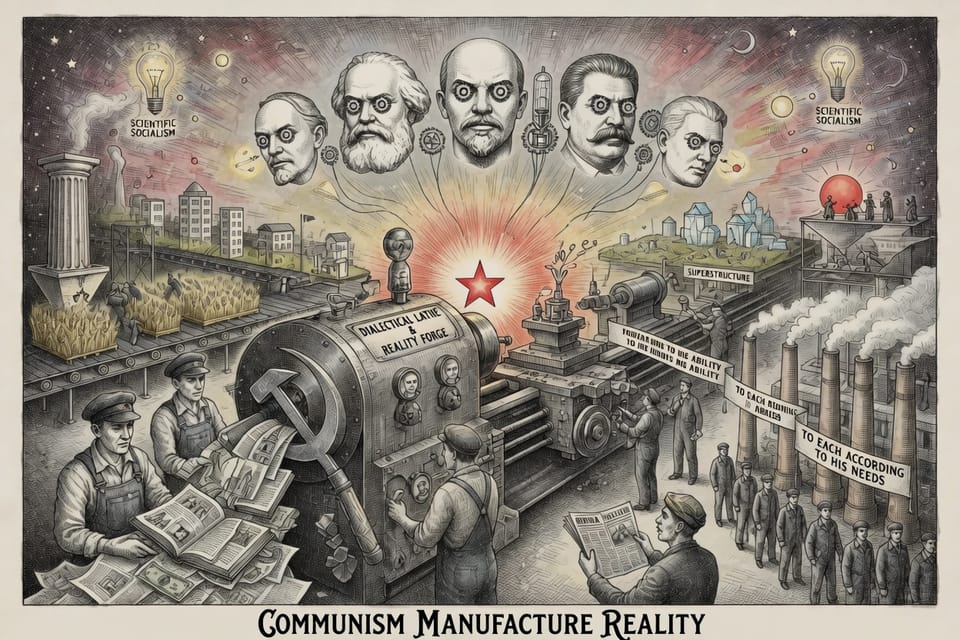
In The Origins of Totalitarianism (1951), Arendt named a phenomenon she had observed in both Nazi Germany and Stalinist Soviet Union: not ordinary propaganda, not merely the suppression of truth, but the active manufacture of a fully alternative reality. A totalitarian regime, she argued, does not simply lie. It constructs a parallel world in which the lie is the foundation of everything, and every institution of society is rebuilt around that foundation.
The most frightening thing, she wrote, is not that people are deceived. The most frightening thing is that people lose the ability to tell the difference between what is real and what is not.
This piece follows that mechanism across three decades of history in Germany, the Soviet Union, and China, and then into the world we live in now.
How the Machine Works
Before getting into specific examples, it helps to understand the mechanics. "Manufacturing reality" is not simply one person writing a false story and spreading it around. It is more layered than that.
The first layer is the monopoly on information. When a single source controls everything people hear, read, and see, there is no other reference point for comparison. You cannot know a piece of information is wrong if you have no access to the right one.
The second layer is relentless repetition. Psychological research consistently shows that people tend to rate information as more credible the more times they encounter it, even when they initially knew it was false. This is called the illusory truth effect. Propaganda does not need to convince you immediately. It just needs to keep going long enough.
The third layer is the erasure of competing memory. It is not enough to control new information. The past must also be deleted, rewritten, or discredited. When there is nowhere to look back to, there is no way to check the present story against anything.
The fourth layer, and this is what Arendt emphasised most, is the destruction of private thought. When people are afraid to speak the truth, they gradually stop thinking it. When you are required to repeat false stories in every social setting, to denounce neighbours, to attend rallies praising a leader you do not believe in, the line between what you actually think and what you say begins to blur. Humans adapt. And that adaptation is ultimately what the totalitarian system is after.
Goebbels' Germany: Propaganda as Craft
Joseph Goebbels was not a stupid man. He had a doctorate in German literature from Heidelberg, read widely, wrote well, and understood crowd psychology with a precision that is still disturbing to read about. Which makes what he did as Reich Minister of Propaganda (1933-1945) worth examining carefully.
Goebbels understood that nobody willingly accepts a crude lie shoved in their face. He approached the whole thing like a craft: get the emotion right first, logic second. Films, music, architecture, national festivals, uniforms, collective rituals, all of it was mobilised to create a feeling of belonging and power before anyone had a chance to examine what they were being asked to believe.
Leni Riefenstahl's Triumph of the Will (1935) is the clearest example. As a piece of filmmaking it was technically brilliant. As a political instrument it turned a Nazi Party rally in Nuremberg into something close to a religious ceremony, with Hitler descending from the clouds like a messiah. The audience was not being asked to accept any argument. They were being invited into a feeling.
Alongside this came comprehensive media control. Goebbels considered radio his most powerful weapon. The German government manufactured and sold cheap radios called Volksempfänger (People's Receivers), designed to receive only domestic broadcasts. By 1939, around 70% of German households had one, the highest penetration rate in the world at the time. This was not accidental. It was the infrastructure of reality manufacture.
What Goebbels grasped, and what Arendt later analysed, is that the goal was never to make every German believe everything the regime said. People still had private doubts, still talked quietly at home. The real goal was to make people behave as if they believed, to erode their confidence in their own judgment, and to leave them with no alternative reference points to check against.
Stalin's Soviet Union: Rewriting the Past as an Industry
If Nazi Germany was the master of emotion and aesthetics, the Soviet Union under Stalin was the master of controlling history and collective memory. And here, what Arendt called the "manufacture of reality" took forms that still make readers stop and blink.
Perhaps the most remarkable single story is the fate of the Great Soviet Encyclopedia. When Lavrentiy Beria, the head of the secret police and one of Stalin's closest allies, was arrested and executed in 1953, the encyclopedia's editorial board sent letters to every library and subscriber. Each letter contained replacement pages with new text about the geography of the Bering Sea, along with specific instructions: use these pages to paste over the entries about Beria and trim away the old sections. This was not a metaphor. This was a documented real-world procedure that thousands of people carried out.
Trotsky is the better-known example. Leon Trotsky was one of the founders of the Red Army, the military architect of the 1917 revolution, arguably the second most important figure in early Soviet history after Lenin himself. But after Stalin had him expelled in 1929 and eventually assassinated in 1940, Trotsky was removed from every photograph, every textbook, every official document. Images that had included him were retouched. His name vanished from official history. Generations of Soviet citizens grew up not knowing who he was.
What is notable is that this did not only happen to enemies. Even genuine heroes could disappear from history overnight if they fell out of favour. This created a very particular kind of anxiety: nobody was safe, nothing was certain, and even events you had personally witnessed could be contradicted by the official version. When even your own memory becomes unreliable compared to the state's version of events, disorientation becomes the norm.
The Moscow Trials (1936-1938) pushed this further still. Veteran communist leaders, people who had devoted their lives to the revolution, stood before courts and confessed to crimes that any outside observer could see they could not have committed: conspiring with Nazi Germany, sabotaging the economy, espionage. Many had been tortured. But some, and this is the genuinely disturbing part, appeared to sincerely believe that confession was necessary "to serve the party." When reality has been thoroughly enough manufactured, even victims can lose their sense of direction within it.
Mao's China: When an Entire Generation Gets Erased
The story of the Great Leap Forward (1958-1962) is one of the most chilling examples in history of manufactured reality leading directly to catastrophe at massive scale.
In 1958, Mao launched the Great Leap Forward, a campaign of agricultural collectivisation and forced industrialisation with production targets so unrealistic they would be comic if the consequences had not been so horrific. Steel and grain outputs were supposed to double or triple within a few years. Peasants were pulled from harvesting crops to smelt steel in backyard furnaces.
The result was famine. But here is the critical point: while tens of millions of people starved in the countryside, the official apparatus continued reporting record production figures upward through the system. Local officials knew that reporting failure meant punishment, so they reported false success. Provincial officials knew they had targets to meet, so they continued exporting grain and extracting food from peasants even as people died. Because according to the official numbers, there was no famine.
Historian Frank Dikötter, working from local archives that were declassified decades later, estimated the death toll from the Great Leap Forward at around 45 million people. The largest man-made famine in recorded human history. And it happened in part because reality had been so thoroughly manufactured that the system had lost the capacity to recognise the truth and respond to it.
The Cultural Revolution (1966-1976) was then a direct assault on memory and thought itself. Millions of books were burned. Temples were destroyed. Professors, doctors, musicians, and artists were dragged before crowds of students to be denounced. An entire generation was taught that history began with Mao, that everything before was "feudal garbage," and that the only truth worth knowing was in the Quotations from Chairman Mao, the Little Red Book that everyone was required to carry.
When a whole generation grows up not knowing their country's actual past, the manufacture of reality is complete.
And Elsewhere...
Germany, the Soviet Union, and China are not the only cases. Every totalitarian system has its own version of this.
In North Korea, people are still living inside one of the largest ongoing laboratories for manufactured reality on earth. The Kim family has been deified in something close to a literal religious sense. The country's history has been rewritten entirely around them.
In various parts of Asia and elsewhere, several post-colonial regimes built mythologies around their founding figures, stories that over time became so fused with national identity that questioning them came to feel like an act of betrayal rather than honest enquiry. Stories of the perfect leader who had no family because he gave his whole life to the nation, who sought no power and no personal gain, who lived only for the people. These stories got repeated through school textbooks, films, and official commemorations until they became "truth that needs no verification." And that, really, is the most telling sign that a manufactured story has succeeded: when it no longer needs to be defended, when asking questions about it is itself treated as the problem.
The Modern World: When the State Machine is No Longer Needed
This is where the story gets more complicated and more troubling than anything Arendt could have anticipated.
In 2016, the Oxford Dictionaries chose post-truth as their word of the year, defined as a state in which objective facts are less influential in shaping public opinion than emotional appeals and personal beliefs. The timing was not random. 2016 was also the year of Brexit and the US election, two events in which misinformation played a role unlike anything previously seen in democratic elections.
But what is important to understand is this: in the modern world, the manufacture of reality no longer requires an authoritarian state to run it. It can run itself through the architecture of social media.
The algorithm does not care about truth. Facebook, YouTube, TikTok, and X were designed to maximise user time on platform, not to maximise the quality of information. Consistent research shows that angry, fearful, and shocking content keeps users engaged longer than accurate and balanced content. The result is that algorithms tend to amplify exactly the kind of content most capable of manufacturing reality: emotionally charged misinformation.
Echo chambers are the natural outcome. When you are only exposed to people who agree with you, when every piece of information you see confirms what you already believe, your ability to recognise false information weakens over time. This is not naivety or stupidity. It is a normal human psychological response to an information environment designed to optimise engagement rather than accuracy.
Vladimir Putin understood this better than most. Russia's information strategy was never really about convincing Western audiences to believe the Russian version of events. The strategy was to flood the zone with contradictory stories so that people no longer knew what to believe. Researcher Peter Pomerantsev described this as "nothing is true and everything is possible." When people distrust every information source, when scepticism becomes total, they tend to retreat toward whatever feels emotionally closest and most familiar, which is often the most extreme position.
And then there is artificial intelligence. Deepfake videos are becoming harder to detect. AI can generate thousands of false news articles in seconds. Anyone's voice can be cloned. We are entering a period where even direct visual evidence can no longer be trusted absolutely.
What Protects Us?
Arendt was not nihilistic about this. She believed there were things that worked against the manufacture of reality, not because they were invincible, but because they still existed and were worth protecting.
A genuinely public space for honest argument. Not social media designed to maximise engagement, but spaces where people can actually debate based on facts and evidence. Independent journalism, for all its failings, remains one of the most important mechanisms we have.
Collective memory, actively maintained. Knowing history, knowing what actually happened and what mechanisms produced past disasters, is a form of inoculation. Totalitarian systems always attack history first. That is not an accident.
Critical thinking at the individual level. The most basic questions Arendt suggested: Who is saying this? In whose interest? And where else can I check this? Simple questions, but asked often enough, they make a real difference.
Conclusion: Reality Cannot Defend Itself
Perhaps the most important thing Arendt wanted to say is that reality cannot defend itself simply by virtue of being real. Truth does not automatically win. It needs to be sought, verified, defended, and passed on.
From Goebbels writing propaganda scripts in the 1930s, to Stalin's officials pasting new pages into encyclopedias, to Mao burning books and closing universities, to today's algorithms optimising for outrage rather than accuracy, the underlying mechanism has stayed the same: control what people are exposed to, repeat it long enough, and erase the competing reference points.
The question of the 21st century is not whether the manufacture of reality is happening. The question is who is doing it, for what purpose, and whether we can recognise it quickly enough to push back.
Chế Tạo Thực Tại: Khi Nói Dối Đủ Lâu Sẽ Thành Sự Thật
Khi bạn còn không biết mình không biết
Năm 1984, George Orwell viết về một xã hội mà lịch sử được viết lại mỗi ngày, rằng "ai kiểm soát quá khứ thì kiểm soát tương lai." Đó là tiểu thuyết. Nhưng ba năm trước khi Orwell xuất bản cuốn đó, Hannah Arendt đã chứng kiến điều tương tự xảy ra ngoài đời thực, không phải trong tưởng tượng, mà ở các quốc gia châu Âu giữa ban ngày ban mặt.
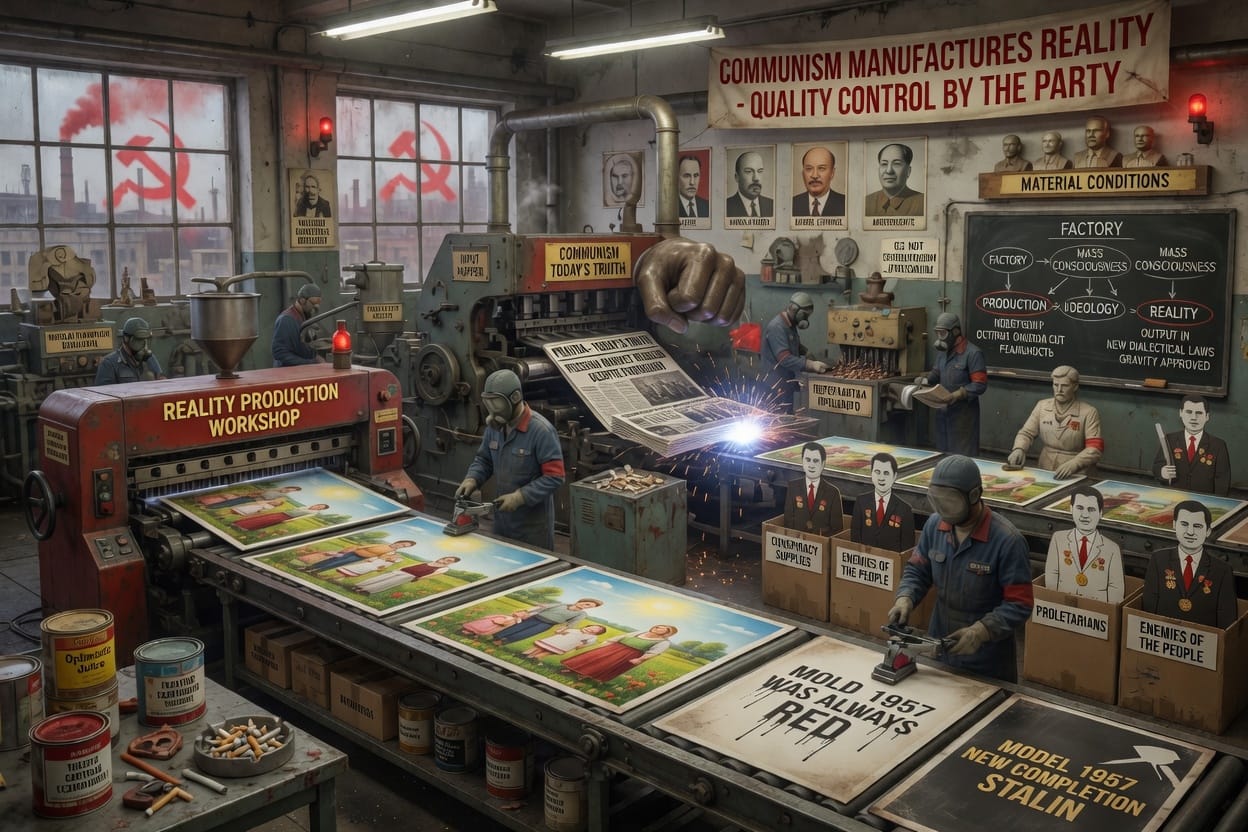
Trong cuốn The Origins of Totalitarianism (1951), Arendt đặt tên cho một hiện tượng mà bà quan sát được ở cả Đức Quốc Xã lẫn Liên Xô Stalin: không chỉ là tuyên truyền thông thường, không chỉ là che giấu sự thật, mà là việc chế tạo một thực tại hoàn toàn thay thế (the manufacture of reality). Chế độ toàn trị, theo Arendt, không đơn giản là dối trá. Nó tạo ra một thế giới song song nơi dối trá là nền tảng của mọi thứ, và từng tế bào của xã hội được tái cấu trúc xung quanh cái nền tảng đó.
Điều đáng sợ nhất không phải là người ta bị dối trá. Điều đáng sợ nhất là người ta mất đi khả năng phân biệt thật và giả.
Bài viết này nhìn vào cơ chế đó, qua ba thập kỷ ở Đức, Liên Xô, Trung Quốc, và sau đó ở thế giới hiện đại nơi chúng ta đang sống.
Cỗ máy vận hành như thế nào
Trước khi đi vào từng ví dụ cụ thể, cần hiểu cơ chế. Việc "chế tạo thực tại" không phải là một người ngồi viết một câu chuyện giả rồi phát tán. Nó phức tạp hơn và có nhiều tầng lớp hơn thế.
Tầng đầu tiên là độc quyền thông tin. Khi một nguồn duy nhất kiểm soát tất cả những gì mọi người nghe, đọc, và xem, thì không có điểm tham chiếu nào khác để so sánh. Bạn không thể biết một thông tin là sai nếu bạn không có thông tin đúng để đối chiếu.
Tầng thứ hai là lặp lại không ngừng. Nghiên cứu tâm lý học cho thấy rằng con người có xu hướng đánh giá một thông tin là đáng tin hơn khi họ nghe nó nhiều lần, ngay cả khi họ ban đầu biết nó là sai, một hiện tượng được gọi là illusory truth effect. Tuyên truyền không cần thuyết phục bạn ngay lập tức. Nó chỉ cần lặp lại đủ lâu.
Tầng thứ ba là xoá bỏ ký ức thay thế. Không chỉ kiểm soát thông tin mới, mà còn xoá, viết lại, hoặc làm mất uy tín những thông tin cũ không phù hợp với câu chuyện mới. Khi quá khứ bị xoá, không có nơi nào để quay lại kiểm chứng.
Tầng thứ tư, và đây là điều Arendt nhấn mạnh nhiều nhất, là phá huỷ không gian riêng tư của tư duy. Khi con người sợ nói thật, họ bắt đầu ngừng nghĩ thật. Khi bạn phải lặp đi lặp lại những câu chuyện mà bạn biết là sai trong đủ mọi hoàn cảnh, khi bạn phải tố cáo hàng xóm, khi bạn phải tham gia mít tinh ca ngợi người lãnh đạo mà bạn không tin, thì dần dần ranh giới giữa những gì bạn thực sự nghĩ và những gì bạn nói bắt đầu mờ đi. Con người thích nghi. Và sự thích nghi đó là kết quả cuối cùng mà chế độ toàn trị muốn đạt được.
Nước Đức của Goebbels: Tuyên Truyền Như Một Nghề Thủ Công
Joseph Goebbels không phải là người dốt. Ông ta có bằng tiến sĩ về văn học Đức từ Đại học Heidelberg, đọc rộng, viết giỏi, và hiểu tâm lý đám đông một cách tinh tế đến mức đáng sợ. Điều đó làm cho những gì ông ta làm với vai trò Bộ trưởng Tuyên truyền Đế chế Đức (1933-1945) càng đáng được phân tích kỹ.
Goebbels hiểu rằng không ai tự nguyện chấp nhận một câu chuyện dối trá được đưa ra một cách thô thiển. Ông ta tiếp cận vấn đề như một nghề thủ công: phải đặt đúng cảm xúc trước, lý trí sau. Phim ảnh, âm nhạc, kiến trúc, lễ hội quốc gia, đồng phục, nghi lễ tập thể, tất cả đều được huy động để tạo ra một cảm giác thuộc về, một cảm giác hùng mạnh, trước khi người ta kịp đặt câu hỏi về nội dung.
Bộ phim Triumph of the Will (1935) của Leni Riefenstahl là ví dụ điển hình nhất. Về mặt kỹ thuật điện ảnh, đây là một tác phẩm thiên tài. Về mặt chính trị, nó biến một cuộc mít tinh của đảng Quốc Xã ở Nuremberg thành một buổi lễ gần như thần thánh, với Hitler xuất hiện như một vị cứu tinh hạ trần. Người xem không được yêu cầu tin vào bất cứ lập luận nào. Họ chỉ được mời vào một cảm giác.
Bên cạnh đó là kiểm soát phương tiện truyền thông triệt để. Đài phát thanh được Goebbels xem là vũ khí mạnh nhất của mình. Chính phủ Đức sản xuất và bán hàng loạt chiếc radio giá rẻ có tên Volksempfänger (máy thu phát của nhân dân), thiết kế chỉ bắt được các kênh trong nước. Đến năm 1939, khoảng 70% hộ gia đình Đức có radio, tỉ lệ cao nhất thế giới lúc đó. Đây không phải sự ngẫu nhiên. Đây là cơ sở hạ tầng của việc chế tạo thực tại.
Điều Goebbels hiểu, và điều mà Arendt sau này phân tích, là mục tiêu không phải là làm cho người Đức tin vào mọi thứ chế độ nói. Người ta vẫn hoài nghi, vẫn nói chuyện riêng trong nhà. Mục tiêu thực sự là làm cho người ta hành động như thể họ tin, làm cho họ mất niềm tin vào khả năng phán đoán của chính mình, và làm cho họ không có điểm tham chiếu thay thế nào để so sánh.
Liên Xô của Stalin: Viết Lại Quá Khứ Như Một Ngành Công Nghiệp
Nếu Đức Quốc Xã là bậc thầy về cảm xúc và thẩm mỹ, thì Liên Xô dưới Stalin là bậc thầy về việc kiểm soát lịch sử và ký ức tập thể. Và ở đây, cái mà Arendt gọi là "manufacture of reality" thể hiện theo những cách mà cho đến nay vẫn còn làm người đọc giật mình.
Câu chuyện đáng biết nhất có lẽ là số phận của Bách Khoa Toàn Thư Liên Xô. Khi Lavrentiy Beria, trùm cảnh sát mật và là một trong những người gần Stalin nhất, bị bắt và xử tử năm 1953, toà soạn bách khoa toàn thư gửi thư đến tất cả các thư viện và cá nhân đăng ký với tờ báo. Trong thư có kèm theo các trang bài viết mới về địa lý Biển Bering, với chỉ dẫn cụ thể: hãy dùng những trang này dán đè lên các trang viết về Beria và cắt bỏ phần cũ đi. Đây không phải ẩn dụ. Đây là quy trình thực tế, được ghi lại rõ ràng trong lịch sử, mà hàng nghìn người đã thực hiện.
Trotsky là ví dụ thậm chí còn nổi tiếng hơn. Leon Trotsky là một trong những người sáng lập Hồng Quân, là kiến trúc sư quân sự của cuộc Cách mạng 1917, là nhân vật quan trọng thứ hai chỉ sau Lenin trong những năm đầu Liên Xô. Nhưng sau khi bị Stalin trục xuất năm 1929 và ám sát năm 1940, hình ảnh của ông bị xoá khỏi mọi bức ảnh, mọi sách giáo khoa, mọi tài liệu chính thức. Những bức ảnh có ông trong đó được chỉnh sửa lại, tên ông biến mất khỏi lịch sử chính thức, và thế hệ người Liên Xô lớn lên sau đó không biết ông là ai.
Điều đáng chú ý là việc này không chỉ xảy ra với những kẻ thù của chế độ. Ngay cả những người từng là anh hùng cũng có thể biến mất khỏi lịch sử sau một đêm nếu họ rơi vào tầm ngắm của Stalin. Điều này tạo ra một bầu không khí bất an rất đặc biệt: không ai an toàn, không có gì chắc chắn, ngay cả những sự kiện mà bạn đã tự mình trải qua cũng có thể bị phủ nhận bởi phiên bản lịch sử chính thức.
Các phiên toà thanh trừng lớn (1936-1938), hay còn gọi là Moscow Trials, đẩy điều này lên một bậc khác nữa. Những lãnh đạo cộng sản kỳ cựu, những người đã cống hiến cả đời cho cách mạng, bước lên toà án và thú nhận những tội ác mà người ta biết họ không thể đã làm, như âm mưu với Đức Quốc Xã, phá hoại kinh tế, gián điệp. Nhiều người trong số họ đã bị tra tấn. Một số khác, và đây mới là điều thực sự ám ảnh, dường như thật sự tin rằng cần phải thú nhận để "phục vụ đảng." Khi thực tại đã bị chế tạo lại đủ triệt để, ngay cả nạn nhân cũng có thể mất khả năng định hướng trong thực tế.
Trung Quốc của Mao: Khi Cả Một Thế Hệ Bị Xoá Trắng
Câu chuyện về Đại Nhảy Vọt (1958-1962) là một trong những ví dụ đáng kinh hoàng nhất trong lịch sử về việc chế tạo thực tại dẫn đến thảm hoạ quy mô lớn.
Năm 1958, Mao công bố Đại Nhảy Vọt, một chiến dịch tập thể hoá nông nghiệp và công nghiệp hoá cấp tốc với những mục tiêu phi thực tế đến mức buồn cười nếu không phải hậu quả quá thảm khốc. Sản lượng thép và lúa được đặt mục tiêu tăng gấp đôi, gấp ba trong vài năm. Nông dân bị huy động đi luyện thép trong các lò cao dã chiến thay vì thu hoạch mùa màng.
Kết quả là nạn đói. Nhưng đây là điều quan trọng: trong khi hàng chục triệu người chết đói ở nông thôn, bộ máy chính thức tiếp tục báo cáo con số sản xuất tăng vọt lên cấp trên. Cán bộ địa phương biết rằng nếu báo cáo thất bại thì họ sẽ bị trừng phạt, nên họ báo cáo thành công giả. Cán bộ tỉnh biết mình cần đạt chỉ tiêu nên họ tiếp tục xuất khẩu gạo ra nước ngoài và lấy lương thực từ nông dân ngay cả khi người dân đang chết đói. Bởi vì theo các con số chính thức, không có nạn đói nào cả.
Nhà nghiên cứu Frank Dikötter, dựa trên hồ sơ lưu trữ địa phương được giải mật sau này, ước tính số người chết trong Đại Nhảy Vọt là khoảng 45 triệu người. Đây là nạn đói do con người tạo ra lớn nhất trong lịch sử nhân loại. Và nó xảy ra một phần vì thực tại đã được chế tạo lại đến mức hệ thống không còn có khả năng nhận ra sự thật và phản ứng với nó.
Cách mạng Văn hoá (1966-1976) thì lại là cuộc tấn công trực tiếp vào ký ức và tư duy. Hàng triệu cuốn sách bị đốt. Đền chùa bị phá. Giáo sư, bác sĩ, nhạc sĩ, hoạ sĩ bị đưa ra sân trường cho học sinh đấu tố. Một thế hệ cả nước được dạy rằng lịch sử bắt đầu từ Mao, rằng mọi thứ trước đó là "rác phong kiến," rằng chân lý duy nhất nằm trong Mao Chủ Tịch Ngữ Lục, cuốn Sách Đỏ Nhỏ mà ai cũng phải mang theo người.
Khi cả một thế hệ lớn lên không biết quá khứ thật sự của đất nước mình là gì, thì việc chế tạo thực tại đã hoàn tất.
Và Ở Các Nơi Khác...
Không phải chỉ có Đức, Liên Xô, hay Trung Quốc mới chứng kiến hiện tượng này. Mọi chế độ toàn trị đều có phiên bản riêng của nó.
Ở Bắc Triều Tiên, người ta vẫn đang sống trong một trong những phòng thí nghiệm lớn nhất về chế tạo thực tại còn tồn tại đến ngày nay. Kim Il-sung và các thế hệ sau được thần thánh hoá theo nghĩa đen, gần như theo nghĩa tôn giáo. Lịch sử đất nước được viết lại hoàn toàn xung quanh gia đình họ Kim.
Ở Đông Nam Á và một số nước châu Á khác, nhiều chế độ sau thời kỳ giải phóng thuộc địa đã xây dựng những câu chuyện thần thoại về những người sáng lập quốc gia, những câu chuyện mà theo thời gian trở thành một phần của bản sắc dân tộc và rất khó đặt câu hỏi mà không bị xem là phản quốc.
Câu chuyện về người anh hùng hoàn hảo, người không có gia đình riêng vì đã hiến dâng cả cuộc đời cho đất nước, người không màng địa vị hay quyền lực, những câu chuyện đó được lặp đi lặp lại qua sách giáo khoa, qua phim ảnh, qua hệ thống giáo dục, cho đến khi chúng trở thành "sự thật không cần kiểm chứng." Và đây thực ra là dấu hiệu đáng chú ý nhất của một câu chuyện đã được chế tạo thành công: khi nó không còn cần biện hộ nữa, khi đặt câu hỏi về nó tự nó đã bị xem là sai trái.
Thế Giới Hiện Đại: Khi Bộ Máy Nhà Nước Không Còn Cần Thiết Nữa
Đây là nơi câu chuyện trở nên phức tạp và đáng lo ngại hơn nhiều so với thời Arendt.
Năm 2016, Từ điển Oxford chọn từ của năm là post-truth, hay "hậu sự thật," được định nghĩa là trạng thái trong đó các sự kiện khách quan ít ảnh hưởng đến việc định hình dư luận hơn là những kêu gọi cảm xúc và niềm tin cá nhân. Đây không phải là một sự ngẫu nhiên. Năm 2016 cũng là năm Brexit và bầu cử Mỹ, hai sự kiện mà thông tin sai lệch đóng vai trò chưa từng thấy trong lịch sử bầu cử dân chủ.
Nhưng điều quan trọng cần hiểu là: trong thế giới hiện đại, việc chế tạo thực tại không còn cần một bộ máy nhà nước độc đoán để vận hành. Nó có thể tự vận hành thông qua cấu trúc của mạng xã hội.
Thuật toán không quan tâm đến sự thật. Facebook, YouTube, TikTok, X (trước đây là Twitter) được thiết kế để tối đa hoá thời gian người dùng ở trên nền tảng, không phải để tối đa hoá chất lượng thông tin. Và nghiên cứu nhất quán cho thấy rằng nội dung giận dữ, sợ hãi, và gây sốc giữ người dùng ở lại lâu hơn nội dung chính xác và cân bằng. Kết quả là các thuật toán có xu hướng khuếch đại chính xác những loại nội dung có khả năng chế tạo thực tại nhất: những thông tin sai lệch gây cảm xúc mạnh.
Buồng vang thông tin (echo chambers) là kết quả tự nhiên. Khi bạn chỉ tiếp xúc với những người đồng ý với mình, khi mọi thông tin bạn thấy đều xác nhận những gì bạn đã tin, thì khả năng nhận biết thông tin sai trở nên suy yếu theo thời gian. Đây không phải là sự ngây thơ hay thiếu thông minh. Đây là một phản ứng tâm lý bình thường của con người trước môi trường thông tin được thiết kế để tối ưu hoá sự tương tác thay vì sự chính xác.
Vladimir Putin hiểu điều này rõ hơn hầu hết mọi người. Chiến lược thông tin của Nga không phải là thuyết phục người phương Tây tin vào câu chuyện của Nga. Chiến lược là tạo ra đủ loại câu chuyện mâu thuẫn nhau để người ta không biết tin vào cái gì. Đây là điều được nhà nghiên cứu Peter Pomerantsev gọi là "nothing is true and everything is possible" (không có gì là thật và mọi thứ đều có thể). Khi người ta không tin vào bất cứ nguồn thông tin nào, khi sự nghi ngờ bao trùm tất cả, thì họ có xu hướng quay về tin vào những thứ gần gũi nhất với họ về mặt cảm xúc và bản sắc, thường là những quan điểm cực đoan nhất.
Và rồi còn có trí tuệ nhân tạo. Deepfake video ngày càng khó phân biệt. AI có thể tạo ra hàng nghìn bài báo giả trong vài giây. Giọng nói của bất kỳ ai cũng có thể bị sao chép. Chúng ta đang bước vào một giai đoạn mà ngay cả bằng chứng trực quan cũng không còn đáng tin tuyệt đối.