History & Politics Research Ep4: The Anatomy of a Secular Cult: Marx, Das Kapital, and the Structure of Communist Belief
(Bấm vào đây để xem tiếng Việt)
A Truth Nobody Dares to Say Plainly
How many Vietnamese Communist Party members have ever read Das Kapital in full? Not excerpts, not textbook summaries, but the complete three volumes in their original form or full translation?
The number is almost certainly negligible. And this is not a uniquely Vietnamese problem. Das Kapital is one of the most cited and least finished books in human history. Volume One alone runs more than 800 pages of dense economic argument. Volumes Two and Three were edited and published by Engels after Marx's death. Even Lenin, who considered himself Marx's most faithful disciple, admitted he had to read the work multiple times to grasp parts of it.
And yet millions of people died for the doctrine written inside it.
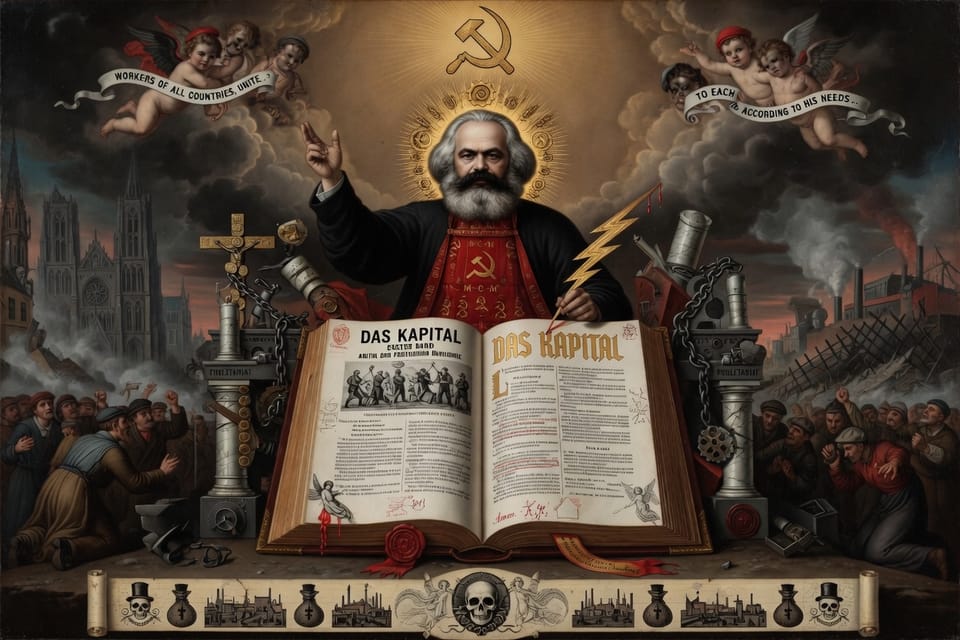
This is not strange if we stop viewing communism as a political theory and start recognising it for what it functionally became: something very close to a secular religion, or more precisely a political cult, complete with scripture, deity, priests, congregation, heresy, and holy war.
What Marx Did That No One Before Him Could
Before Marx, the European left was strikingly diverse and fragmented. Robert Owen built model communities in Scotland. Charles Fourier dreamed of phalanstères (self-governing communal villages). Proudhon declared "property is theft." Bakunin demanded the immediate abolition of all states. Each had a different approach, each group pulled in a different direction, and none could unify the others.
What Marx achieved, which none of his predecessors managed, was to systematise and "scientise" all of those grievances into a single, complete doctrine that appeared to carry the inevitability of natural law.
He did not merely say "capitalism is unjust": he proved through economics that exploitation was an inescapable internal mechanism of the capitalist system (surplus value). He did not simply call for revolution: he declared revolution to be a historical inevitability, as unstoppable as gravity. And he distinguished his doctrine from all other socialisms with one decisive word: "scientific." Everything else was "utopian."
This was the turning point. A doctrine that calls itself "scientific" cannot be argued with, because arguing with science means you are wrong, not the science.
And this step created the greatest danger: no more diverse, fragmented left. Only a single central text for authoritarian leaders to select from and exploit.
Bakunin and Proudhon could not be weaponised by Mao or Lenin, because they were opposed to centralised state power. But Marx, with his theory of the "dictatorship of the proletariat" and the vanguard party, provided exactly the handbook that anyone seeking absolute power needed.
The Cult Structure: A Near-Perfect Parallel
Look at the structure of communism and compare it to religion. The parallel is almost complete.
Scripture → Das Kapital and The Communist Manifesto. Few have read them in full, but everyone declares their belief. The original text is inviolable: not to be criticised, not to be questioned.
God → Karl Marx, deified after death. His portrait hung everywhere. His name spoken with reverence. His quotes used as prayer. No one could say Marx was wrong.
Apostles → Lenin, Stalin, Mao, Ho Chi Minh. Each "interpreted" Marx for their own circumstances, adding new layers of doctrine: Marxism-Leninism, Mao Zedong Thought, Ho Chi Minh Thought. Each claimed to be the "creative development" of Marx. None admitted to revising or contradicting him.
Parish priests → Political commissars, ideology cadres, political education teachers. They interpret the scripture for the congregation that cannot read it themselves. Whoever controls the interpretation of Marx controls everything.
Congregation → Party members, the masses. No need to understand, only to believe and obey.
Heresy → Counter-revolutionary, bourgeois thinking, ideological wavering. Consequences: imprisonment, forced labour, execution. The Inquisition tried those who doubted God. The people's courts tried those who doubted the Party.
Heaven → The classless, stateless communist society. A promise of a perfect future that cannot be verified now, but is sufficient to justify any sacrifice in the present.
The Devil → The bourgeoisie, imperialists, counter-revolutionaries. Every cult needs a defined enemy to maintain internal cohesion.
The Engels Paradox: When a Believer Won't Pay the Real Price
The story of Friedrich Engels illustrates most clearly the internal contradiction of someone who believes in a doctrine but cannot bring themselves to live by it.
Engels was the factory owner who funded the theory against factory owners. He managed Ermen & Engels in Manchester, extracting surplus value from workers (exactly the mechanism Marx described), then used that profit to support Marx in writing that this was a crime.
He sold his share of the factory in 1869 and spent the rest of his comfortable life in London on investment income. Not through labour. Not by giving up his privileges.
More striking: if a communist revolution had truly succeeded in the full sense of the word, Engels would have lost everything. No factory, no investments, no capacity to direct his own life. Mary Burns, the woman he loved, still lived and died in poverty regardless of how much money or theory he possessed.
In psychology, this is called cognitive dissonance: holding two contradictory beliefs simultaneously without breaking. Religious believers do this constantly: believing in heaven but fearing death. Believing in material renunciation but keeping possessions. Believing in equality but enjoying privilege.
Engels was not simply a hypocrite. He genuinely believed in the theory, but in the way of a believer, not in the way of someone willing to pay the real price. And this is precisely how most communist party members everywhere "believed," while the ordinary people below them paid the actual cost.
Why a Fragmented Left Would Have Been Less Dangerous
This is the least discussed but most important point.
If Marx had not "systematised and scientised" social grievances into a single doctrine, left-wing movements of the 19th and 20th centuries would still have existed, but in diverse, fragmented forms that were far harder to weaponise.
The reason is simple: dictatorship requires a single text to legitimise its power. You cannot rule in the name of "many different theories." You cannot claim to be the only one who "correctly understands" something when there is no single thing to understand correctly or incorrectly.
Marx inadvertently created the perfect handbook for dictatorship: a "scientific" doctrine claiming historical inevitability, with a clear enemy, a clear promise of paradise, and an organisational structure (the vanguard party) that allowed a small group to seize power in the name of the majority.
Lenin took that handbook. Stalin took it. Mao took it. Each took the parts that suited them, discarding what didn't fit, adding what they wanted, while still declaring absolute loyalty to Marx.
In Vietnam: The Cult Imported Whole
This cult structure was exported to Vietnam along with the doctrine. Ho Chi Minh was deified while still alive and especially after his death. His last will and testament became a sacred text. "Studying and following Ho Chi Minh Thought" is a regular ritual, like daily prayer. Those who questioned party policy were "lacking in political standpoint," "ideologically wavering," or in harsher periods, outright "counter-revolutionary."
This is not communism in any Marxist sense. This is a secular cult with the full apparatus of control; and like every cult, it survived not because followers understood the doctrine but because followers were afraid to ask questions.
Conclusion: Recognising the Structure
Eric Hoffer wrote in The True Believer (1951): "Mass movements can rise and spread without belief in a God, but never without belief in a devil."
Communist believers and extreme religious believers share the same psychological structure: the need for a clearly defined enemy, the need for a promise of a perfect future, the need for the sense of belonging to a chosen community, and the need to be relieved of the burden of thinking for themselves.
Das Kapital goes unread, just as the Bible goes unfinished, not because it does not matter but because faith does not require understanding, only belief. And once faith has replaced reason, the priest can say whatever he wants.
The tragedy of communism is not that Marx was entirely wrong about inequality. The tragedy is that he was right enough about the real problems of the 19th century that his doctrine could be dressed up as truth, and that he packaged those real grievances so tightly into a single "scientific" text that the worst people of the 20th century found exactly what they needed inside it.
Chủ Nghĩa Cộng Sản như Một Tôn Giáo Thế Tục: Khi Das Kapital Trở Thành Kinh Thánh
Một thực tế không ai dám nói thẳng
Có bao nhiêu đảng viên cộng sản Việt Nam từng đọc hết Das Kapital? Không phải trích dẫn, không phải tóm tắt trong giáo trình, mà là đọc hết ba tập gốc tiếng Đức hoặc bản dịch đầy đủ?
Con số đó gần như chắc chắn là không đáng kể. Và đây không phải chỉ là vấn đề của Việt Nam. Das Kapital là một trong những cuốn sách ít được đọc hết nhất nhưng được trích dẫn nhiều nhất trong lịch sử nhân loại. Tập 1 dày hơn 800 trang với lý luận kinh tế học phức tạp, tập 2 và 3 do Engels biên soạn sau khi Marx mất. Ngay cả Lenin, người tự nhận là môn đồ trung thành nhất của Marx, cũng thừa nhận đã phải đọc nhiều lần mới hiểu được một phần.
Vậy mà hàng triệu người chết vì học thuyết được viết trong đó.
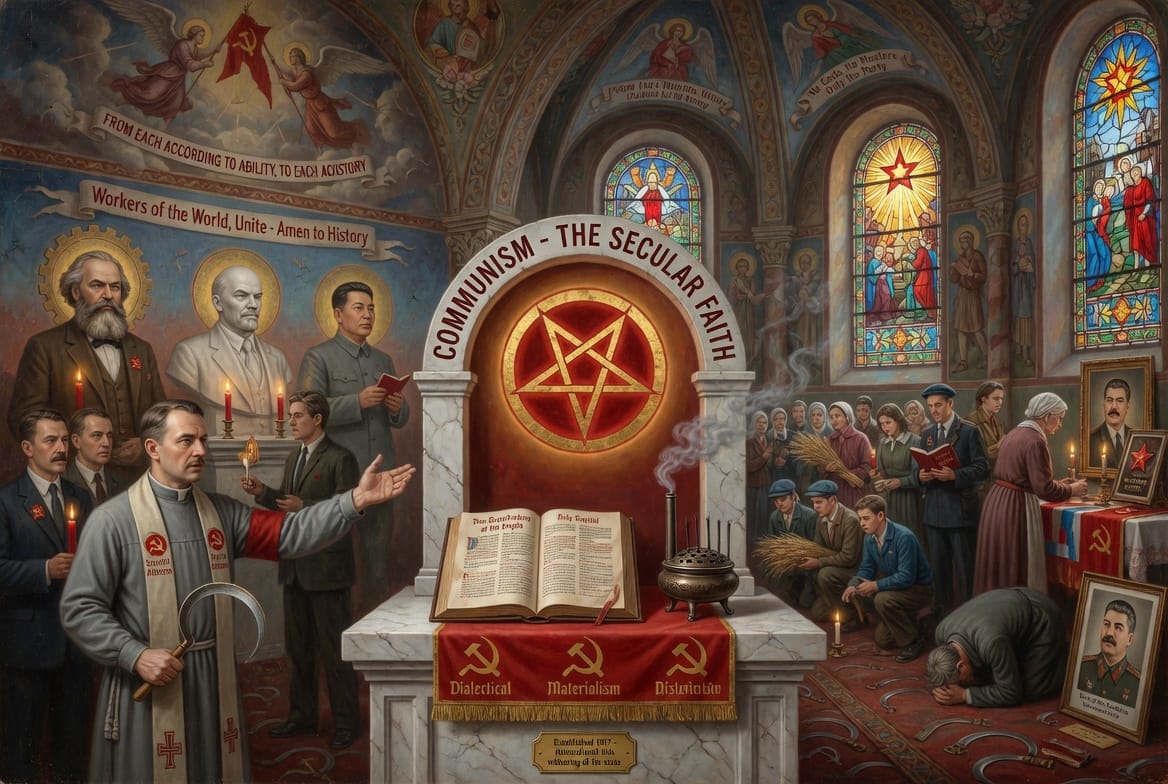
Điều này không có gì là bất thường nếu ta nhìn nhận chủ nghĩa cộng sản không phải như một học thuyết chính trị mà như một thứ gần với tôn giáo, hay chính xác hơn là một giáo phái thế tục với đầy đủ cấu trúc của nó: kinh thánh, thần thánh, cha xứ, con chiên, dị giáo, và thánh chiến.
Marx đã làm gì mà những người trước ông không làm được
Trước Marx, phong trào cánh tả châu Âu rất đa dạng và phân tán. Robert Owen xây cộng đồng kiểu mẫu ở Scotland. Charles Fourier mơ về những phalanstère (làng công xã tự quản). Proudhon hô khẩu hiệu "tài sản là trộm cắp." Bakunin kêu gọi xoá bỏ mọi nhà nước ngay lập tức. Mỗi người một hướng, mỗi nhóm một cách tiếp cận, không ai thống nhất được ai.
Điều Marx làm được, mà không ai trước ông làm được, là hệ thống hoá và "khoa học hoá" tất cả những bất bình đó thành một học thuyết duy nhất, hoàn chỉnh, có vẻ ngoài tất yếu của quy luật tự nhiên.
Ông không chỉ nói "tư bản là bất công": ông chứng minh bằng kinh tế học rằng bóc lột là cơ chế nội tại không thể tránh khỏi của hệ thống tư bản (surplus value). Ông không chỉ kêu gọi cách mạng: ông tuyên bố cách mạng là quy luật tất yếu của lịch sử, không thể cưỡng lại, giống như quy luật trọng lực. Và ông phân biệt học thuyết của mình với các chủ nghĩa xã hội khác bằng một từ khoá quyết định: "khoa học." Còn lại tất cả là "không tưởng."
Đây là bước ngoặt. Một học thuyết tự nhận là "khoa học" thì không thể tranh cãi, vì tranh cãi với khoa học nghĩa là bạn sai, không phải khoa học sai.
Và cũng chính bước này đã tạo ra nguy hiểm lớn nhất: không còn phong trào cánh tả đa dạng, phân tán nữa. Chỉ còn một văn bản trung tâm để các lãnh tụ độc tài chọn lọc và khai thác.
Bakunin và Proudhon không thể bị Mao hay Lenin lợi dụng, vì họ chống lại nhà nước tập trung. Nhưng Marx, với học thuyết về "chuyên chính vô sản" và đảng tiên phong, cung cấp đúng cái cẩm nang mà mọi kẻ muốn nắm quyền tuyệt đối cần.
Cấu trúc giáo phái: Song song hoàn hảo
Nhìn vào cấu trúc của CNCS và so sánh với tôn giáo, sự song song gần như hoàn hảo:
Kinh Thánh → Das Kapital và Tuyên ngôn Đảng Cộng sản. Ít ai đọc hết, nhưng ai cũng tuyên bố tin tưởng. Văn bản gốc bất khả xâm phạm: không được phê bình, không được đặt câu hỏi.
Thiên Chúa → Karl Marx, được thần thánh hoá sau khi mất. Ảnh treo khắp nơi, tên gọi thiêng liêng, lời trích dẫn được dùng như kinh cầu nguyện. Không ai dám nói Marx sai.
Các Thánh Tông đồ → Lenin, Stalin, Mao, Hồ Chí Minh. Mỗi người "giải thích" Marx cho hoàn cảnh của mình, thêm vào các tầng giáo lý mới: Chủ nghĩa Marx-Lenin, Chủ nghĩa Mao Trạch Đông Tư tưởng, Tư tưởng Hồ Chí Minh. Mỗi tầng đều tự nhận là "sự phát triển sáng tạo" của Marx, không ai thừa nhận là đang sửa đổi hay phủ nhận Marx.
Cha xứ → Chính trị viên, cán bộ tư tưởng, giáo viên giáo dục chính trị. Họ là người giải thích kinh thánh cho con chiên không đọc được kinh. Ai kiểm soát việc giải thích Marx, người đó kiểm soát tất cả.
Con chiên → Đảng viên, quần chúng nhân dân. Không cần hiểu, chỉ cần tin và phục tùng.
Dị giáo → Phản cách mạng, tư tưởng tư sản, dao động tư tưởng. Hậu quả: tù tội, lao động khổ sai, tử hình. Toà án dị giáo thời Trung Cổ xử tội không tin Chúa. Toà án nhân dân thời cộng sản xử tội không tin Đảng.
Thiên đường → Xã hội cộng sản không giai cấp, không nhà nước. Lời hứa về tương lai hoàn hảo, không thể kiểm chứng ngay bây giờ, nhưng đủ để biện minh cho mọi hy sinh hiện tại.
Quỷ Satan → Giai cấp tư sản, đế quốc, phản cách mạng. Cần có kẻ thù để duy trì sự gắn kết của giáo phái.
Nghịch lý Engels: Khi tín đồ không tin đến cùng
Câu chuyện về Friedrich Engels minh hoạ rõ ràng nhất mâu thuẫn nội tại của người tin vào học thuyết nhưng không dám sống thật với nó.
Engels là ông chủ nhà máy tài trợ cho lý thuyết chống ông chủ nhà máy. Ông quản lý Ermen & Engels ở Manchester, khai thác sức lao động của công nhân (đúng theo cơ chế giá trị thặng dư mà Marx mô tả), rồi dùng lợi nhuận đó nuôi Marx viết lý thuyết rằng điều đó là tội ác.
Ông bán cổ phần nhà máy năm 1869 và sống thoải mái phần đời còn lại bằng tiền đầu tư. Không phải bằng lao động. Không phải bằng cách từ bỏ đặc quyền.
Điều thú vị hơn là: nếu cách mạng cộng sản thực sự xảy ra và thành công theo đúng nghĩa của nó, Engels sẽ mất tất cả. Không còn nhà máy, không còn đầu tư, không còn khả năng điều phối cuộc sống của mình. Mary Burns, người phụ nữ ông yêu, vẫn sống và chết trong nghèo túng dù ông có bao nhiêu tiền và lý thuyết.
Trong tâm lý học, đây gọi là cognitive dissonance: giữ cùng lúc hai niềm tin mâu thuẫn nhau mà không bị vỡ. Tín đồ tôn giáo cũng làm điều này thường xuyên: tin vào thiên đường nhưng sợ chết. Tin vào sự từ bỏ vật chất nhưng giữ tài sản. Tin vào bình đẳng nhưng hưởng đặc quyền.
Engels không phải kẻ giả dối đơn thuần. Ông thực sự tin vào học thuyết, nhưng theo kiểu của tín đồ, không phải theo kiểu của người sẵn sàng trả giá thực sự. Và đây chính xác là cách mà hầu hết đảng viên cộng sản ở mọi nơi đã "tin tưởng," trong khi những người bình thường bên dưới trả giá thật sự.
Tại sao sự phân tán cánh tả sẽ ít nguy hiểm hơn
Đây là điểm ít được nói đến nhất nhưng quan trọng nhất.
Nếu Marx không "hệ thống hoá và khoa học hoá" những bất bình xã hội thành một học thuyết duy nhất, phong trào cánh tả thế kỷ 19-20 sẽ vẫn tồn tại, nhưng ở dạng đa dạng, phân tán, và khó bị lợi dụng hơn nhiều.
Lý do đơn giản: độc tài cần một văn bản duy nhất để hợp pháp hoá quyền lực. Không thể nhân danh "nhiều học thuyết khác nhau" để đàn áp. Không thể tuyên bố "tôi là người duy nhất hiểu đúng" khi không có gì để hiểu "đúng" hay "sai."
Marx vô tình tạo ra cái cẩm nang hoàn hảo cho độc tài: một học thuyết "khoa học" tự nhận là tất yếu lịch sử, với kẻ thù rõ ràng, với lời hứa thiên đường rõ ràng, và với cấu trúc tổ chức (đảng tiên phong) cho phép một nhóm nhỏ nắm quyền nhân danh số đông.
Lenin lấy cái cẩm nang đó. Stalin lấy. Mao lấy. Và mỗi người lấy phần phù hợp với mình, bỏ phần không phù hợp, thêm phần mình muốn, trong khi vẫn tuyên bố trung thành tuyệt đối với Marx.
Kết luận: Nhận ra cấu trúc
Eric Hoffer viết trong The True Believer (1951): "Phong trào quần chúng có thể thay thế nhau cho nhau, không phải vì họ giống nhau về học thuyết, mà vì họ đáp ứng cùng một nhu cầu tâm lý."
Tín đồ cộng sản và tín đồ tôn giáo cực đoan chia sẻ cùng một cấu trúc tâm lý: cần có kẻ thù rõ ràng, cần có lời hứa về tương lai hoàn hảo, cần cảm giác thuộc về một cộng đồng được chọn lựa, và cần được giải phóng khỏi gánh nặng của việc phải tự suy nghĩ.
Das Kapital không được đọc, giống như Kinh Thánh không được đọc hết, không phải vì nó không quan trọng mà vì đức tin không cần hiểu, chỉ cần tin. Và khi đức tin đã thay thế lý trí, cha xứ muốn nói gì cũng được.